
Understanding the Root
What Is the Perfect Storm?
If your child has multiple overlapping challenges and no one has been able to connect the thread, this is the explanation most families never get.
The question behind every complicated child
You've probably been to multiple specialists. You've filled out intake forms that ask about sleep, behavior, digestion, focus, and sensory responses. You've gotten diagnoses, or you haven't. You've tried things that helped a little, or not at all.
And somewhere in the middle of all of it, a question keeps surfacing: why does my child have so many things going on at once?
The Perfect Storm is the answer to that question.
It is not a diagnosis. It is not a label. It is an explanation for why so many children today are struggling with overlapping challenges that don't fit neatly into a single category. And why addressing the nervous system changes the picture when everything else hasn't.
The Model
Three layers. One nervous system.
The Perfect Storm develops in a specific sequence. Each layer compounds the one before it.
Prenatal Stress
The nervous system begins forming within the first weeks of pregnancy. Long before a baby is born, the mother's stress response directly shapes how the baby's autonomic nervous system develops. Chronic prenatal stress elevates cortisol and activates the sympathetic nervous system in the developing baby. The result is a nervous system that comes into the world already biased toward fight-or-flight, already running harder than it should have to. This is the foundation. Everything built on top of it is affected by how stable that foundation is.
Birth Trauma
Birth is the most physically demanding event of a human life, for both mother and baby. Even in uncomplicated deliveries, the forces involved in moving through the birth canal place significant stress on the upper cervical spine and brainstem. When interventions are involved (forceps, vacuum extraction, prolonged pushing, C-section, or rapid delivery) those forces increase substantially. The result is often subluxation at the upper cervical spine: neurological interference that disrupts the brainstem's ability to regulate the body's systems. The brainstem controls breathing, heart rate, digestion, immune function, sleep, and the body's ability to shift between sympathetic and parasympathetic states. When it's under stress from day one, the downstream effects are immediate and wide-ranging.
Early Childhood Stressors
The third layer is what compounds the first two. For many children, the early years bring a cascade of additional stressors that the already-taxed nervous system cannot absorb: repeated ear infections treated with multiple rounds of antibiotics, colic that never fully resolved, reflux, difficulty sleeping, missed developmental milestones, reactions to vaccines or environmental exposures, chronic gut disruption from early antibiotic use that depletes the microbiome and further compromises the gut-brain axis. Each of these, on its own, might be manageable. Together, layered on top of a nervous system that was already compromised before birth, they create the Perfect Storm.
Why the nervous system is the common thread
The Autonomic Nervous System governs every system in the body. It regulates digestion, immune response, sleep, heart rate, breathing, hormone production, and the body's ability to respond to stress and return to calm.
When the ANS is dysregulated, specifically when it is stuck in sympathetic dominance, the effects are not limited to one system. They show up everywhere, because the nervous system is everywhere.
This is why Perfect Storm children often have gut issues alongside behavioral challenges, sleep problems alongside sensory sensitivities, and immune dysregulation alongside focus and learning difficulties. These are not separate problems. They are different expressions of the same underlying dysregulation.
The clinical term for this is dysautonomia: an imbalance between the sympathetic and parasympathetic branches of the ANS. The gas pedal is stuck on. The brake pedal is underactive. The body cannot regulate itself the way it should.
What Perfect Storm children look like
Parents describe these children in similar ways, regardless of the specific diagnoses on the chart.
Intense from birth
Colic, reflux, or both in the newborn period
Sleep struggles
Never settled easily, still wakes frequently
Missed milestones
Late or asymmetrical crawling, skipped crawling entirely
Sensory sensitivities
Sounds, textures, transitions, or crowds are overwhelming
Multiple diagnoses
ADHD, SPD, anxiety, or autism. Often arriving one at a time.
Gut issues alongside behavior
Constipation, reflux, or chronic illness running alongside focus or regulation challenges
The diagnoses that follow (ADHD, sensory processing disorder, autism spectrum disorder, anxiety, chronic illness) often arrive one at a time, from different specialists, without anyone connecting the thread that runs through all of them. That thread is the nervous system.
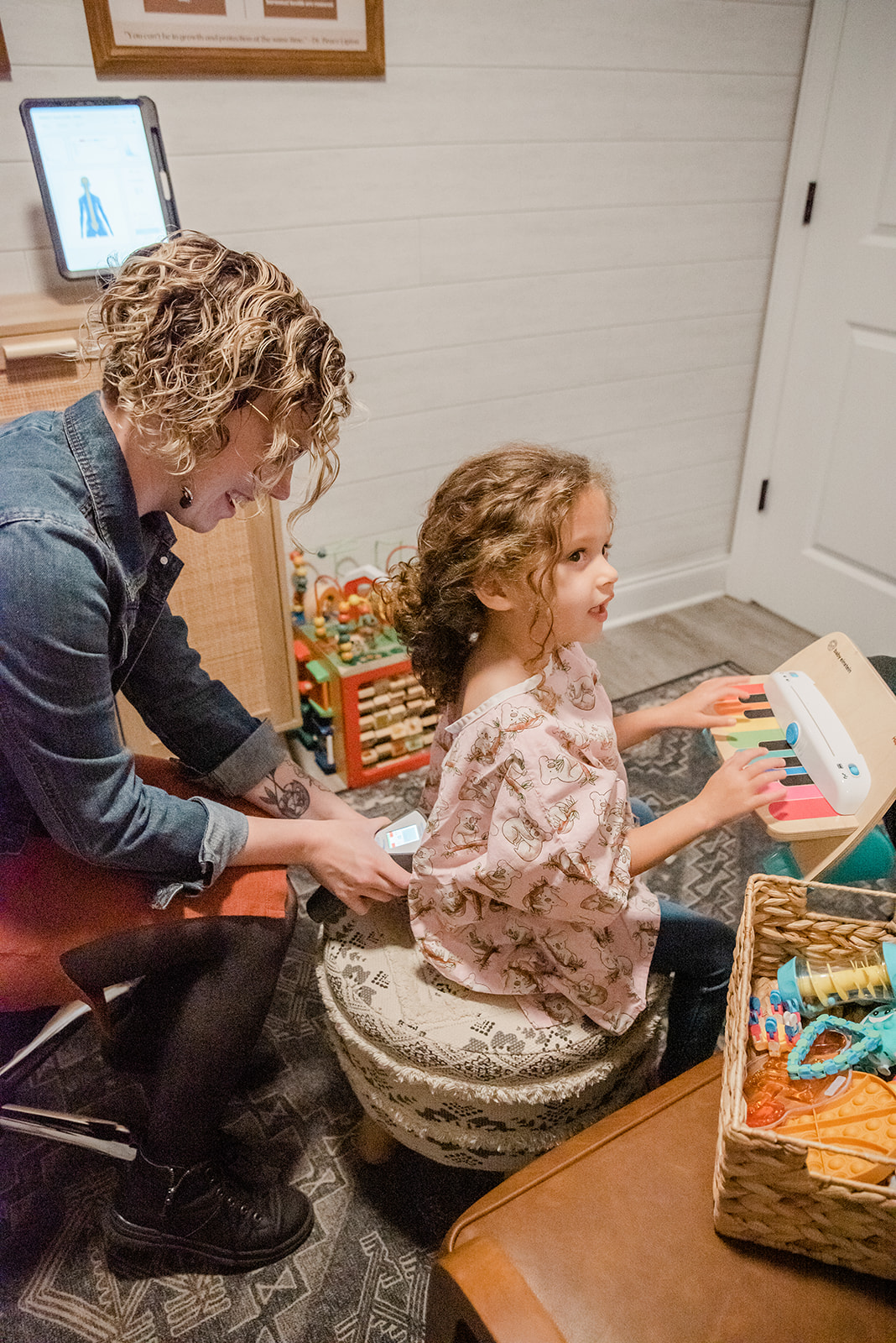
Objective Data
We measure the nervous system before we recommend anything
The INSiGHT scan is a three-part, non-invasive assessment that measures how the nervous system is regulating. It looks at heart rate variability, muscle tension patterns along the spine, and thermal asymmetry.
Together, these give us an objective picture of where the stress is concentrated. Not based on a checklist of behaviors. Based on real physiological data.
Safe for children of all ages from day one of life. No radiation, no needles, no discomfort.
What Changes
The nervous system heals in a specific order
Parents who bring Perfect Storm children in for care describe a consistent pattern of changes over time. Sleep improves first, often within the first few weeks. Digestion follows. Emotional regulation becomes more consistent. Sensory tolerance increases. Focus and learning begin to shift.
These changes happen in a specific order because the nervous system heals in a specific order. The body prioritizes the most fundamental functions first, then works outward. This is not a quick fix. The Perfect Storm took years to develop. Unwinding it takes time, consistency, and a clear understanding of what's actually being addressed.
How our care plan worksQuestions parents ask about the Perfect Storm
What exactly is the Perfect Storm?
The Perfect Storm is a model used in neurologically-focused chiropractic care to describe how a specific sequence of stressors, beginning before birth and compounding through early childhood, which can disrupt the developing nervous system in ways that affect everything downstream. It's not a diagnosis. It's an explanation for why so many children today have multiple overlapping challenges that don't fit neatly into a single category.
How is this different from a standard ADHD or autism diagnosis?
A diagnosis describes what a child's behavior looks like. The Perfect Storm model asks why the nervous system is producing that pattern in the first place. Many children with ADHD, autism, SPD, or anxiety have underlying nervous system dysregulation that drives those presentations. Addressing the dysregulation doesn't erase the diagnosis, but it changes what the child can access.
Can chiropractic care actually help with something this complex?
Neurologically-focused chiropractic care addresses the nervous system directly, not just the spine. Using INSiGHT scanning technology, we get an objective picture of where the nervous system is under stress. Specific, gentle adjustments work to reduce that interference and restore the nervous system's ability to regulate. The changes parents notice in sleep, digestion, emotional regulation, and sensory tolerance follow from that foundation shifting.
How do I know if my child fits the Perfect Storm pattern?
If your child has multiple overlapping challenges, if the diagnoses keep coming without a unifying explanation, if you've tried everything and something still feels like it's being missed, the nervous system is worth looking at. The INSiGHT neurological assessment takes about 30 minutes and gives us objective data on how your child's nervous system is actually functioning.
How young can a child start care?
We see children from day one of life. The birth process, even in uncomplicated deliveries, puts significant stress on the upper cervical spine and brainstem. Early assessment and care can make a real difference in how a child develops.
What does the care actually look like for a Perfect Storm child?
It starts with a full consultation and INSiGHT neurological scan. We schedule a separate Report of Findings to walk you through what we found before recommending anything. Care plans for Perfect Storm children are typically longer-term because the nervous system took years to develop these patterns. We track progress with repeat scans so you can see the changes objectively, not just feel them.
More questions?
Read the full FAQReady to look at the foundation?
Most families wish they'd come in sooner.
The first visit is a conversation and a scan. We tell you what we find before we recommend anything. Call us at (865) 671-0359 or book online.