What Causes Torticollis in Babies?
You noticed it first. Perhaps your baby always turns their head to the right. Maybe they nurse well on one side but struggle on the other. The pediatrician might have mentioned "torticollis" at the two-week visit and provided a referral for physical therapy.
Now you're here, at 11pm, seeking to understand what that word actually means.
Here's what you need to know.
What Torticollis Actually Is
Torticollis is a tightening of the sternocleidomastoid (SCM) muscle on one side of the neck. This is the long muscle that runs from behind the ear down to the collarbone. When it's shortened or in spasm, the baby's head tilts toward the tight side and rotates away from it.
You'll observe it as a consistent head tilt, a preference for looking in one direction, difficulty turning to nurse on both sides, or a flattening on one side of the skull (plagiocephaly) from always resting the same way.
It's more common than most parents realize. Estimates suggest between 1 in 250 and 1 in 300 newborns have some degree of torticollis at birth.
Where It Comes From
The most common cause is birth.
This isn't because something went wrong. Birth is physically demanding for a baby, even when everything goes well. The baby's head and neck are compressed, rotated, and pulled through the birth canal. In longer labors, that compression lasts for hours. In assisted deliveries involving vacuum or forceps, the forces on the cervical spine increase significantly.
The outcome is often tension in the upper cervical spine, particularly at C1 and C2, the first two vertebrae at the base of the skull. When those joints are restricted or misaligned, the muscles around them compensate by tightening. The SCM is one of the first muscles to respond.
This is why torticollis tends to appear in babies who experienced:
- Long or stalled labors
- Vacuum or forceps-assisted delivery
- C-sections (the extraction process still involves significant force on the neck)
- Posterior positioning in the womb (sunny-side up)
- Multiples, where space was limited
It can also develop postnatally from positioning, but birth is the most common driver.
Why the Nervous System Matters Here
The upper cervical spine isn't just a structural issue. The brainstem sits right there, at the junction of the skull and C1. It controls heart rate, breathing, digestion, sleep, and the stress response. When there's tension or restriction at that level, the nervous system interprets it as a threat and responds accordingly.
This is why many babies with torticollis also experience colic, reflux, poor sleep, or difficulty latching. These are not separate problems. They are manifestations of the same nervous system under stress, expressing itself in different ways.
Physical therapy addresses the muscle. That's helpful. However, if the underlying restriction in the upper cervical spine isn't addressed, the muscle continues to receive the same signal to stay tight.
What We Look For
When a baby presents with torticollis, we begin with the INSiGHT neurological scan. It provides an objective picture of how the nervous system is functioning before we proceed with any physical examination. We assess where the tension is located, how the autonomic nervous system is responding, and whether there's asymmetry in the brainstem region.
Then we examine the cervical spine, the cranial bones, and the jaw. Torticollis often accompanies cranial asymmetry, tension in the temporomandibular joint, and restriction in the upper thoracic spine. We consider the whole picture, not just the tight muscle.
Both Dr. Devin and Dr. Jeremy are trained in SOT cranial technique for infants, which addresses tension in the skull bones that can contribute to head tilt and feeding difficulties.
What Adjustments Look Like for a Baby
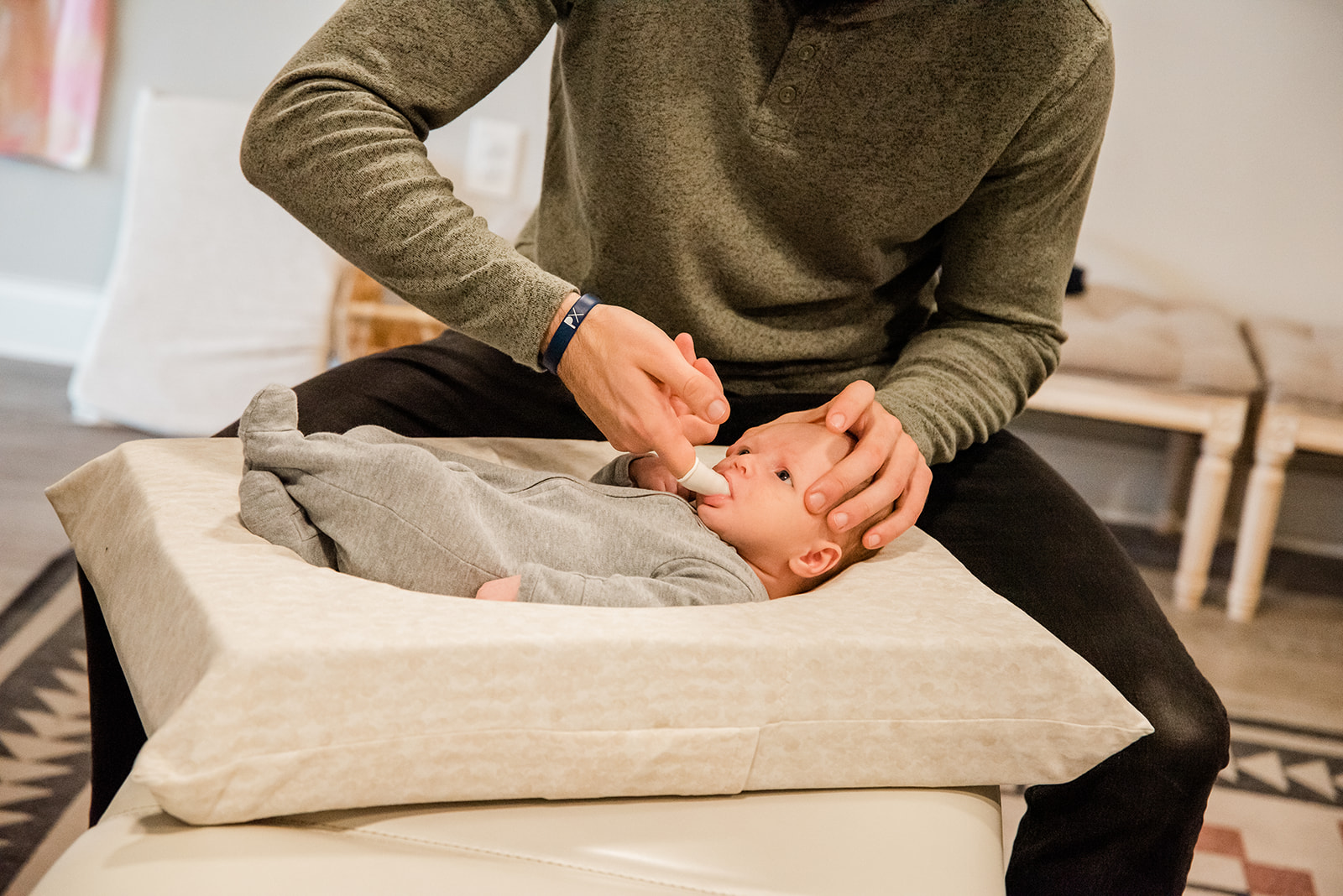
The pressure used for an infant adjustment is similar to what you'd use to check the ripeness of a tomato. There is no cracking, no popping, no manipulation in the way most adults envision it. A specific, gentle contact at the correct joint, held for a few seconds, is sufficient to change the signal the nervous system is receiving.
Most babies sleep through it. Some fuss briefly and then settle. Parents are often surprised by how different it is from what they expected.
What Parents Notice
The changes typically appear in a specific order. First, the baby starts turning their head more freely in both directions. Then nursing on the previously difficult side improves. Next, sleep gets better. Finally, the fussiness that seemed unrelated begins to decrease.
That sequence makes sense when you understand what was driving it. The nervous system was stuck in a stress response. As the upper cervical restriction resolves, the brainstem receives a different signal. The entire system starts to settle.
When to Bring Your Baby In
If your baby has a consistent head tilt or rotation preference, bring them in. The earlier torticollis is addressed, the less compensation the body has to build around it.
If your baby is nursing well on both sides, sleeping reasonably, and has no visible tilt, a check is still valuable after a difficult birth. Restriction in the upper cervical spine doesn't always manifest as torticollis. Sometimes it appears as colic, reflux, or poor sleep, and the tilt is subtle enough to be missed.
We check every baby after birth. This is not a sales line. It's because birth is the most physically stressful event most humans ever experience, and the nervous system deserves the same attention we give the lungs and the heart.
If your baby has been diagnosed with torticollis, or if something just feels off and you're unsure what to do next, request an appointment at Reissing Health. We're in Farragut, serving Knoxville, Powell, Oak Ridge, and the surrounding areas.
We'll tell you what we find.
To learn more about how we approach newborn and infant care at our Farragut clinic, visit our newborn chiropractic care page.
Related Service
Explore Newborn Chiropractic Care
Explore Reissing Health
Written & Reviewed By
Dr. Devin Reissing, DC, CACCP
Dr. Devin Reissing is a CACCP-certified pediatric and prenatal chiropractor and PX Docs provider in Farragut, TN. He specializes in neurologically-focused chiropractic care for children with sensory processing challenges, ADHD, autism, colic, and developmental delays, as well as Webster-certified prenatal care.
View Full Bio →Have questions before you book?
Most families who find us have already tried everything else. If you're ready to look at the nervous system, we're here.