Pediatric Chiropractor Knoxville: The Complete Guide for Parents
Pediatric Chiropractor Knoxville: The Complete Guide for Parents
Most parents who find us have already been to the pediatrician. They have already done the referrals. They have already tried the medications, the elimination diets, the therapies. And their child is still struggling.
What they have not yet had is someone look at the nervous system.
That is what pediatric chiropractic care at Reissing Health is built around. Not adjusting spines for the sake of it. Not treating symptoms with a different tool. Looking at the actual control system running your child's body and asking: is this working the way it should?
This guide covers what pediatric chiropractic care actually is, which children benefit most, what the research says, what to expect at a first visit, and how to know if it is the right fit for your family.
---
What Is Pediatric Chiropractic Care?
Pediatric chiropractic care is not a scaled-down version of adult care. The approach, the technique, the pressure used, and the goals are all different.
At its core, pediatric chiropractic care addresses the relationship between the spine and the nervous system. The spine houses the spinal cord. The spinal cord is the main communication highway between the brain and every organ, gland, and tissue in the body. When there is mechanical stress on the spine, particularly in the upper cervical region near the brainstem, it can interfere with how the nervous system functions.
In children, this interference often shows up not as back pain, but as colic, ear infections, sleep disruption, constipation, sensory overwhelm, difficulty regulating emotions, or immune challenges. The symptom looks unrelated to the spine. The root cause is not.
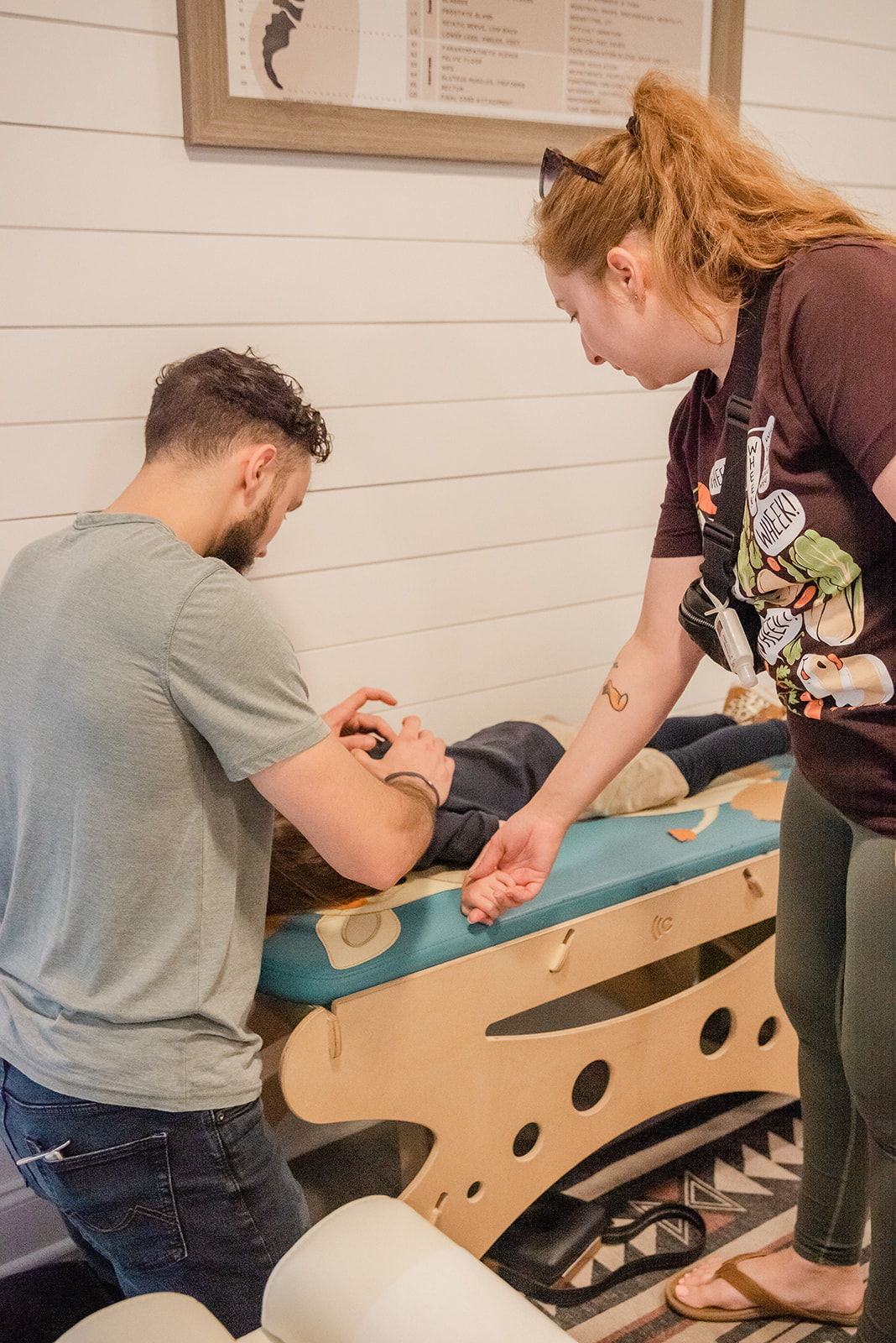
The adjustment itself, for an infant, uses no more pressure than you would use to test the ripeness of a peach. For a toddler or school-age child, it is slightly more but still far lighter than what most people imagine. There is no cracking, no twisting, no force. The goal is to restore clean neurological communication, not to manipulate a joint.
---
Why the Nervous System Is the Starting Point
Here is the thing most parents are not told: the nervous system runs everything.
Heart rate. Digestion. Immune response. Sleep cycles. Emotional regulation. Sensory processing. All of it is coordinated by the nervous system, specifically by the autonomic branch that operates below conscious awareness.
When a child's nervous system is stuck in a chronic stress response, also called sympathetic dominance, the body cannot do any of those things well. The child cannot sleep deeply because the nervous system is still on alert. The gut cannot move efficiently because the parasympathetic "rest and digest" signal is suppressed. The immune system cannot modulate properly because the stress hormones are constantly elevated. The child cannot self-regulate because the prefrontal cortex is being overridden by a brainstem that thinks there is still a threat.
This is not a behavior problem. It is not a parenting problem. It is a nervous system that never got the signal that it was safe to come down.
Pediatric chiropractic care, specifically neurologically-focused care, works to restore that signal. When the upper cervical spine is clear and the vagus nerve is firing properly, the parasympathetic system can do its job. Digestion improves. Sleep deepens. Immune function stabilizes. Sensory tolerance expands. The child who was impossible to settle starts to settle.
---
Which Children Benefit Most
We see children across a wide range of ages and presentations. The common thread is nervous system stress. Here is what that looks like in practice.
Newborns and Infants
Birth is the most physically demanding event a newborn will ever experience. Even in uncomplicated vaginal deliveries, the forces on the cervical spine during descent and delivery are significant. C-sections, vacuum or forceps use, prolonged labor, and cord complications add additional mechanical stress.
The result is often a baby who cannot latch properly, who is excessively fussy, who does not sleep in stretches, who has reflux or colic that does not respond to feeding changes. We see these babies as young as a few days old. The adjustment for a newborn is extraordinarily gentle, and families often notice changes within the first few visits.
For a deeper look at what we check and why, read Infant Chiropractor Knoxville: Why We Check Every Baby After Birth.
Babies with Torticollis
Torticollis, where a baby consistently tilts or rotates the head to one side, is one of the most common conditions we see in infants. It is almost always rooted in upper cervical tension from birth positioning or delivery mechanics. Stretching alone does not address the underlying joint restriction. We do. Most families see meaningful improvement within the first several visits.
Read more: The Real Reason Stretching Isn't Fixing Your Baby's Torticollis and What Causes Torticollis in Babies?.
Children with Chronic Ear Infections
The anatomy matters here. The Eustachian tube in young children runs nearly horizontal, making drainage difficult. When the upper cervical spine is restricted, the muscles and lymphatics around the tube are also affected, compounding the drainage problem. Antibiotics clear the infection. They do not restore drainage. The infections come back.
A 1996 study published in the Journal of Clinical Chiropractic Pediatrics followed 332 children with chronic ear infections. After chiropractic care, 80% had no further infections within six months. That is not a small number.
Read more: Can Chiropractic Help with Ear Infections in Kids? and Overcoming Chronic Ear Infections with Pediatric Chiropractic Care.
Children with Constipation
The gut and the nervous system are in constant communication. The vagus nerve, which runs from the brainstem down through the thoracic and lumbar spine, carries the parasympathetic signal that tells the gut to move. When there is tension at C1 or in the thoracic spine, that signal is dampened. The gut slows down. Constipation follows.
This is why MiraLAX works until you stop it, and then the problem returns. It is not addressing the signal. We are.
Read more: Can Chiropractic Help with Constipation in Kids? and Is MiraLAX Making Your Child's Behavior Worse?.
Children with Colic and Reflux
Colic is one of the most exhausting things a parent can go through. A baby who cries for three or more hours a day, three or more days a week, for three or more weeks, with no identifiable cause. The standard answer is that they will grow out of it.
Some do. Many do not, and the underlying nervous system dysregulation that drove the colic shows up later as sensory issues, sleep problems, or immune challenges.
Chiropractic care for colic addresses the vagus nerve and the upper cervical spine. When the parasympathetic system is firing properly, the gut calms, gas moves, and the baby settles. Read more: Do Infants Grow Out of Colic? and The Health Test Your Pediatrician Isn't Running.
Children with ADHD, Autism, and Sensory Processing Challenges
This is the area where neurologically-focused chiropractic care has the most to offer, and where the most parents have been failed by the mainstream model.
ADHD, autism, and sensory processing disorder are not separate conditions with separate causes. They are different expressions of the same underlying pattern: a nervous system that is stuck in overdrive, unable to filter sensory input, unable to regulate emotional response, unable to shift out of fight-or-flight.
Chiropractic care does not treat autism or ADHD as diagnoses. What it does is address the nervous system dysregulation that is driving the symptoms. When the brainstem is no longer firing in a chronic stress response, children sleep better, digest better, tolerate sensory input better, and regulate their emotions more effectively. Their teachers notice. Their therapists notice.
Read more: Neurodivergent Chiropractor Knoxville: CACCP-Certified Care for Sensory, ADHD, and Autism and What's Actually Going On in Your ADHD Child's Nervous System.
Children with Developmental Delays
When the nervous system is under chronic stress, development slows. Motor milestones, language, social engagement, and cognitive processing all depend on a nervous system that is available for growth rather than consumed by threat response.
We work alongside occupational therapists, speech therapists, and developmental pediatricians. We are not replacing those services. We are addressing the neurological foundation that makes those services more effective.
Read more: Hope for Developmental Delays: Finding Success Outside Standard Therapies.
Children with Immune Challenges and Seasonal Allergies
The immune system does not operate independently of the nervous system. The vagus nerve directly modulates inflammatory response. When the vagus nerve is functioning well, the immune system can respond appropriately to threats and then stand down. When it is not, the immune system stays activated, overreacts to pollen and food proteins, and struggles to clear infections efficiently.
Read more: The Missing Link in Childhood Immunity and Why Is My Child Allergic to Spring?.
---
What Makes Reissing Health Different
There are chiropractors who see children. There are pediatric chiropractors. And then there is what we do.
Both Dr. Devin Reissing and Dr. Jeremy Cerha hold the CACCP credential, which stands for Certified in Advanced Chiropractic Pediatrics. It is awarded by the Academy of Chiropractic Family Practice and requires 200 post-doctoral hours in pediatric neurology, development, and clinical care, followed by board examinations. Fewer than 900 chiropractors in the United States hold it. Reissing Health is the only clinic in the Farragut and Knoxville area with two CACCP-certified doctors on staff.
Both doctors have also completed the Peak Potential Institute's SOT Pediatric Practitioner Certificate Program, which includes specific training in cranial adjusting for infants and children. Cranial work addresses tension in the bones of the skull that can affect feeding, sleep, and sensory processing. It is especially relevant for babies with tongue and lip ties, plagiocephaly, or latching difficulties.
Dr. Devin Reissing is also Advanced Webster Certified through the ICPA and affiliated with the PX Docs network, a national group of neurologically-focused pediatric chiropractors.
To understand what the CACCP credential means in practice, read What Is a CACCP Chiropractor? Why This Certification Changes Everything for Your Child.
---
The INSiGHT Neurological Scan
We do not guess. We measure.
The INSiGHT scan is an FDA-registered neurological assessment system that measures three things: NeuroThermal patterns (which show how the autonomic nervous system is regulating organs and glands along the spine), NeuroSpinal EMG (which measures muscle tension and asymmetry), and Heart Rate Variability (which reflects the overall adaptability and resilience of the nervous system).
The scan takes about 10 minutes. It is non-invasive, painless, and safe for newborns. It gives us an objective picture of what is happening neurologically before we touch your child, and we re-scan regularly so you can see measurable changes over time rather than just hoping something is working.
This is what separates a neurologically-focused approach from a symptom-based one. We are not treating the ear infection or the colic or the meltdown. We are measuring the system that is producing all of those things and addressing the root.
---
The Perfect Storm
Many of the children we see fit a specific pattern that Dr. Tony Ebel of the PX Docs network calls the Perfect Storm. It is a sequence of stressors, typically beginning in pregnancy or at birth, that leave the nervous system stuck in a chronic stress response.
The pattern usually looks like this: a difficult pregnancy (high stress, illness, interventions), a complicated delivery (C-section, vacuum, prolonged labor), followed by early antibiotic use, formula supplementation, or other factors that further stress the developing nervous system. The child who comes out of that sequence is not starting from zero. They are starting from a deficit.
Understanding the Perfect Storm changes how parents see their child's struggles. It is not random. It is not their fault. And it is not permanent.
Read more: The Real Reason Why Your Child Is So Sick.
---
What to Expect at the First Visit
The first visit at Reissing Health is not a quick adjustment and out the door. It is a conversation, a scan, and a plan.
We start by listening. Most parents who come to us have a long story, and we want to hear it. The birth history, the early months, the interventions tried, the specialists seen. That history tells us a great deal about what the nervous system has been through.
Then we run the INSiGHT neurological scan. No X-rays, no guessing. The scan gives us objective data on how the nervous system is functioning right now.
We review the findings with you and build a care plan specific to your child's age, presentation, and health goals. We do not give everyone the same plan. We do not rush.
The adjustment itself, for an infant or young child, is brief and gentle. Most babies sleep through it. Most toddlers barely notice.
For a full walkthrough of what to expect, read Newborn Chiropractor Knoxville: What to Expect at Your Baby's First Visit and Doctors Who Listen: What to Expect From Your New Patient Experience.
---
Frequently Asked Questions
Is chiropractic care safe for babies and young children?
Yes. The pressure used for an infant adjustment is roughly equivalent to what you would use to check if a peach is ripe. Our doctors hold CACCP certification, which requires hundreds of hours of advanced training specifically in pediatric technique and safety.
At what age can a child start chiropractic care?
From birth. We see babies as young as a few days old, particularly after difficult deliveries. The earlier we can assess and address nervous system stress, the better the foundation for development.
How many visits will my child need?
It depends on the child, the history, and the goals. After the initial scan and exam, we give you a specific care plan. Some children see significant changes in a few visits. Others benefit from longer-term care to maintain nervous system function as they grow.
Do you work with other providers?
Yes. We work alongside pediatricians, occupational therapists, speech therapists, and developmental specialists. We are not replacing those services. We are addressing the neurological foundation that makes all of them more effective.
What if my child has never had a chiropractic adjustment?
That is the norm, not the exception. Most families who come to us have never seen a chiropractor before. We walk you through everything, answer every question, and move at whatever pace feels right for your child.
---
Where We Are Located
Reissing Health Family Chiropractic is located at 11657 Parkside Drive, Knoxville, TN 37934, in the heart of Farragut. We serve families from Farragut, Knoxville, Turkey Creek, Hardin Valley, Lenoir City, Oak Ridge, and surrounding communities in West Knoxville and East Tennessee.
If you are looking for a pediatric chiropractor in Knoxville or Farragut, we would be glad to be your family's starting point.
You can request an appointment online at any time or call us at (865) 671-0359. We do not rush first visits.
For more on how we approach pediatric care at Reissing Health, see our pediatric chiropractic care page.
We are located at 11657 Parkside Dr in Farragut. Our Farragut chiropractor page has directions, hours, and more about what makes our clinic different.
Related Service
Explore Pediatric Chiropractic Care
Read More on This Topic
Explore Reissing Health
Written & Reviewed By
Dr. Devin Reissing, DC, CACCP
Dr. Devin Reissing is a CACCP-certified pediatric and prenatal chiropractor and PX Docs provider in Farragut, TN. He specializes in neurologically-focused chiropractic care for children with sensory processing challenges, ADHD, autism, colic, and developmental delays, as well as Webster-certified prenatal care.
View Full Bio →Have questions before you book?
Most families who find us have already tried everything else. If you're ready to look at the nervous system, we're here.